Showing posts with label masters of dance. Show all posts

Wednesday, December 19, 2018

another ballet

the third ballet of the season was mid December and held at my least favorite venue- the Van Wezel Auditorium...however the performances more than made up for the distaste i have for Van Wezel....


My preferences were the order in which they performed these ballets- loving the first and its amazing "skating" dances- especially the incredible moves of the blue boy... the Enigma variations were very good and although I am sure the Diamonds choreography is wonderful it left me as cold as a diamond- and I did not think it was as perfectly performed as it should be...even in this publicity photo you can see some arms in a U shape more than a circle--- this one truly needs perfection and when the movements are done in synchronization the slightest variation stands out like a sore thumb to me... 

however- the critic - whose judgment I respect completely - was happy with it...here is Carrie Seidman's review- 

Looking back on a decade of progress for Sarasota Ballet

By Carrie Seidman - Columnist 

The ‘Victorian Winters’ program of Ashton and Balanchine reflects company’s evolution and growth. The Sarasota Ballet’s third program of the season, “Victorian Winters,” is a triple bill of works previously performed, each one significant in the company’s history over the past decade under director Iain Webb.

“Les Patineurs” was the ballet that staked Sarasota’s claim to the works of British choreographer Frederick Ashton, more than two dozen of which are now in the repertoire; “Enigma Variations,” also by Ashton, had never been performed outside England when it premiered here in 2016, solidifying the company’s reputation for reviving historic, seldom-seen, ballets; and George Balanchine’s “Diamonds,” the finale of his full-length “Jewels,” was the piece the Sarasota performed in 2011 with the Suzanne Farrell Ballet in Washington, D.C., the first of what has now become an annual handful of performances out of state.

Due to a scheduling conflict that required my being out of town for all three of the weekend’s performances at the Van Wezel Performing Arts Hall, I was permitted to view the dress/tech rehearsal, watching (with a few exceptions) the cast that will perform Saturday evening. As someone who has been reviewing the company for the past eight years, there were plenty of déjà vu moments recalling those earlier performances and the dancers — many of them no longer with the company — who performed them.

“Les Patineurs,” choreographed in 1937, debuted in Sarasota in 2008, before my arrival in town. But I was watching in 2011, the night former principal Logan Learned was elevated to principal status after taking ownership of the “Blue Boy” role; and in 2013 at “Ballet Across America” in Washington, D.C., after which New York Times’ critic Alastair Macaulay called it “the finest I’ve seen of this ballet in over 30 years”; and again the following year for the company’s Big Apple debut at New York’s City Center.

Ashton’s accurate interpretation of a Victorian-era skating party (though he’d never visited an ice rink in his life), to music by Giacomo Meyerbeer, is a perpetual crowd pleaser, featuring an elaborate backdrop, period costuming, falling snowflakes and a special floor covering designed to look like ice. The look was a bit different this time because instead of borrowing the sets and costuming from the Birmingham Royal Ballet as in the past, the company recently purchased a little-used production created by Miami City Ballet. Though they aren’t vastly different, those who’ve seen the ballet in the past may note some differences (like the vivid scarlet costuming of the “Red Girls”) and I missed the aura of history that came with the more dated-looking costumes, bearing the sweat of a generation of dancers past.

But the biggest difference for Sarasota viewers will be the absence of Learned, who retired at the end of last season. “Blue Boy,” with its acrobatic solos and quirky head wiggles, had become the diminutive dancer’s signature work and his cadre of loyal local fans will claim no one could do the role as well. But they would be mistaken.

Ivan Duarte, coming off an injury that has kept him out of the first two programs of the season, has the precise and proficient footwork Learned lacked and even more leaping and turning facility. (He also possesses that impressive ability to finish a rapid pirouette sequence with a moment of still suspension on demi-pointe.) His final and endless turns, with one leg a la seconde (extended to the side), as the curtain falls, rises and falls again, were the speediest I’ve ever seen.

Victoria Hulland, replacing Danielle Brown as half of the lead “White Couple” with Jamie Carter, made a more reserved impression; Katelyn May joined Kate Honea as the spirited “Blue Girls,” filling in for the much-missed Nicole Padilla; and the corps was a mix of old and new faces. But the company’s comfortable ease with this now-familiar work remained, and the longer-tenured dancers were evidence of a mature understanding of Ashton’s choreography.

The Sarasota Ballet is the only company given permission to perform Ashton’s “Enigma Variations” outside the Royal Ballet and the Birmingham Royal Ballet, the latter of which loaned the exquisite sets and Victorian-era costuming (Julia Trevelyan Oman). Aron Muhl added a romantic aura with his recreation of Mark Jonathan’s original lighting.

Ashton’s series of character portraits based on the friends of composer Edward Elgar (to whose music of the same name the ballet is set) envisions an imaginary gathering of the melancholic Elgar, then a struggling composer, with his wife and friends at his Worcestershire home. Again, though the casting has shifted since the company gave the ballet its U.S. premiere in 2016, the Sarasota dancers evidenced a growing ease with its theatrical demands. Ricardo Graziano was in fine brooding and pensive form as Elgar, back after a season-long injury, with Hulland as his adoring wife; Thomas Giugovaz mastered the devilishly fast variation of Elgar’s friend, Arthur Troyte Griffith, and Daniel Pratt’s homoerotic moment as Nimrod, was appropriately understated.

Watching “Diamonds” brought me back to the moment when the company first performed the finale of Balanchine’s tryptich — inspired by his admiration of jewelry designer Claude Arpels and choreographed for his muse, Suzanne Farrel, to a grandiose Tchaikovsky score — in a combined performance on the tenth anniversary of Farrell’s own company in Washington, D.C. in 2011. (They performed it again later that season in Sarasota, with the D.C. company as guests.)

Back then I noted Danielle Brown (also returning this year after a season-long injury), dancing with Graziano, was “tentative, a princess hoping to prove herself.” The same duo was scheduled to perform opening night, no doubt with more maturity and greater ease, but I saw the Saturday night casting, with Ellen Overstreet and guest Marcelo Gomes, who, remarkably, has never before danced in this piece. (Gomes, who left American Ballet Theatre in 2017 after a #metoo accusation, was scheduled to dance in New York Friday night and fly to Sarasota in time for the final performance.)

Watching Gomes never grows old, though it won’t be long before he’s past prime for “white tights” roles. But in this case, I barely noticed him. He provided assured partnering in the very long pas de deux, but it was Overstreet I couldn’t tear my eyes from. Her absolute refusal to rush, extending each note of the music with fluid arm movement that continued to trail in one direction even as she moved on to the next step in another was breathtaking. The lush and languid quality of her movement turned her into an exotic yet regal creature, fragile and steely at once. Even during the very grand polonaise finale, with 34 dancers in dazzling rhinestoned costumes (on loan from National Ballet of Canada) filling the stage to capacity, she was the focal draw.

To be able to watch a reprise of these three works that helped make the company the respected entity it is today — and to see the changing cast of dancers continuing to grow and mature in both technical facility and emotional artistry — was a pleasure and testimony to the dedicated commitment of Webb and his wife, assistant director Margaret Barbieri, to putting Sarasota on the ballet map.

and from another article on the current performances- by thomas Becnel-

A miracle on ice’

Sarasota has earned a national reputation with the ballets of Ashton, including “Les Patineurs,” which features a skating party on a frozen pond.

In 2013, the dance critic of the Washington Post, Sarah Kaufman, raved about a Sarasota performance in a “Ballet Across America” program at the Kennedy Center. She called it “big-hearted” and “gorgeous,” marveling that Webb could do so much with such a small company and tiny budget.

“His achievement, and that of his dancers, is nothing short of miraculous,” Kaufman concluded. “Call ‘Les Patineurs’ a miracle on ice.”

This week, at the Van Wezel Performing Arts Hall, the ballet will be accompanied by the Sarasota Orchestra. It will be led by guest conductor Jonathon McPhee, former music director of the Boston Ballet.

On Saturday, the ballet will be joined by guest artist Marcelo Gomes, a former principal dancer with the American Ballet Theatre, who will dance the lead role in “Diamonds.”


Graziano will dance one of the leads in “Enigma” before returning to the stage for “Diamonds” on Friday and at the Saturday matinee. He’s not worried about pulling double duty, though he expects to break a sweat in his Victorian costume for “Enigma.”

so- now three ballet performances into the season I continue to be in awe of the quality of the company - as I always say "they are punching above their weight here" - this is an outstanding company with real talent and they deserve all the recognition they get and more..... 


Sunday, November 25, 2018

the next ballet

The second ballet program for the season happened the night before Phil arrived in town. It was a full bill - running the gamut of styles and spirit....

The dance company is rising to the challenge of honoring three iconic choreographers in 'Masters of Dance.'by: Niki Kottmann  Managing Editor of Arts and Entertainment

The Sarasota Ballet is ready for its most difficult program of the year — and one of the most difficult in Director Iain Webb’s 11 years with the company.

“I wouldn’t have even considered bringing in some of the ballets we’re bringing in three or four years ago,” Webb says. “They’re so hard — we wouldn’t have gotten permission, and we wouldn’t have done them justice.”

But that was a different time. Now, the company has grown enough to properly honor three of the ballet world’s most legendary choreographers — Sir Frederick Ashton, Christopher Wheeldon and Jerome Robbins — in its second program of the year, “Masters of Dance.”

“The people who own the ballets and these trusts — now I think they know Margaret (Barbieri) and I and that we would never do something that wouldn’t show the work to the best of our ability ... it shows how the company’s grown,” Webb says. “I feel more relaxed — I can see more of the horizon for the organization.”

Highly technical, demanding choreography coupled with a short rehearsal schedule — they had just three weeks to prepare — might make some directors nervous. But Webb is confident in his dancers and says the challenge is good for them.

‘RHAPSODY’
The first of the three ballets on the program, “Rhapsody,” is one of the last pieces Ashton ever created, and it’s also one of the few Ashton works The Sarasota Ballet has never staged.   Come Nov. 16, the group will become the only American company to have performed it.


Ashton originally choreographed the piece on acclaimed Russian dancer-choreographer Mikhail Baryshnikov, which makes for big shoes to fill, but Webb likes the technical steps and stamina required that draws the kind of attention usually reserved for the female lead.

“It’s fiendishly difficult ... both technically and stamina-wise,” he says of the male role. “But for all the cast, the counts — (Executive Director) Joseph Volpe came in to watch a rehearsal and couldn’t figure them out.”

Birmingham Royal Ballet Principal Mathias Dingman will be performing said role as a guest artist for the two evening performances, and Webb looks forward to seeing how it pushes his dancers even further.

When he was first starting out with Sarasota Ballet in 2007, Webb says he was adamant about not using guest dancers. But now that he has dancers who can hold their own alongside a star performer, he encourages it.

“The timing is vital,” he says. “What’s worse is if you bring a big famous dancer or guest in and your dancers themselves aren’t that strong … Now when you bring a guest in it sort of lifts the company.”

Webb is also excited to have New York City Ballet Principal Pianist Cameron Grant play “Rhapsody” in the pit with the Sarasota Orchestra under the direction of Royal Ballet Principal Guest Conductor Barry Wordsworth.

‘THERE WHERE SHE LOVED’
The Sarasota Ballet has a special connection to the choreographer of “There Where She Loved,” the second ballet on the “Masters of Dance” program.


In 1990, Assistant Director Margaret Barbieri retired from her position as a principal dancer at The Royal Ballet to become director of the new Classical Graduate Programme at London Studio Centre and artistic director of the school’s annual touring company, Images of Dance. It was during her time at the school that a young dancer-choreographer with great talent caught her eye.

Barbieri gave Wheeldon his first professional commission, a piece he created for Images of Dance, thus helping him kickstart his choreography career and eventually forming a special connection with the artist that has lasted to this day.

Webb says he enjoys coming back to “There Where She Loved” for many reasons, but especially because audiences typically know the music, which is a funky mix of compositions.

“The combination with ‘There Where She Loved’ is really interesting because it’s (music by) Frédéric Chopin and Kurt Weill, and you wouldn’t normally think of mixing the two because the composers are so extremely different,” he says. “But it’s a fun outcome.”

‘THE CONCERT’
The company is celebrating the centennial of choreographer Robbins’ birth with the final ballet of the program, “The Concert.”

This is another piece in which Webb says audiences will know the music, but even those familiar with the piece won’t expect the choreography.

“It’s one of the funniest pieces of choreography around,” he says. ”You’ve got very serious Chopin music, and then you have funny situations happening like being at a concert with someone behind you who suddenly decides to unwrap some cough drops very noisily.”


Robbins was one of the great choreographers for musicals and Broadway along with ballets, Webb says, so there’s many comical and theatrical elements to his choreography.

This brings a whole other challenge for the company.

“It’s always difficult to play comedy,” Webb says. “You’ve got to do the choreography and with the music, that’s what makes it funny. It’s Robbins at his best.”

and the review by Carrie Seidman - who I sat next to for the ballet performances-

A flurry of technique, a tug at the heartstrings and a comedy of (intentional) errors in triple bill
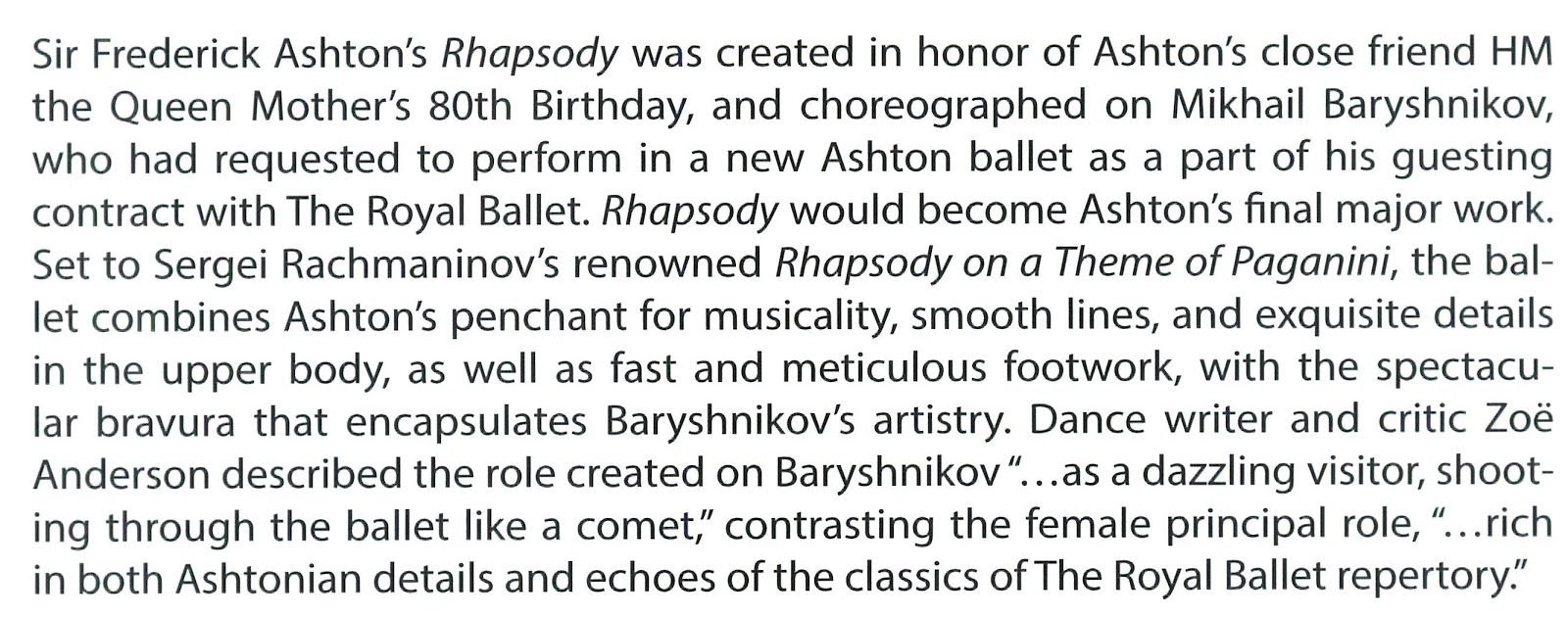
When Frederick Ashton came out of retirement in 1980 to create a ballet honoring the 80th birthday of his old friend, the Queen Mother (Queen Elizabeth), and also to provide a vehicle for Mikhail Baryshnikov’s last guest appearance with the Royal Ballet — the Russian superstar insisted he would only appear if Ashton were the choreographer — he admitted that he “pulled out all the plugs.”
The result was “Rhapsody,” the mix of Russian bombast and British elegance that opened the Sarasota Ballet’s “Masters of Dance” triple bill at the Sarasota Opera House, and was followed by Christopher Wheeldon’s “There Where She Loved” and the company premiere of Jerome Robbins’ “The Concert.”
If Baryshnikov was disappointed — “I was trying to get away from all those steps,” he later complained — the same cannot be said for those watching Ashton’s final oeuvre. (The choreographer died in 1988.) Though prior to this company premiere, the ballet had been revived only three times over nearly four decades, it has been reliably received as a dazzling confirmation of Ashton’s genius and its dancers’ abilities and Friday night’s opening performance was no exception.
The Baryshnikov role calls for a dancer with the speed, strength and stamina to keep up with Ashton’s barrage of precise steps to Sergei Rachmaninov’s “Rhapsody on a Theme of Paganini,” here played sumptuously by the Sarasota Orchestra under the baton of Royal Ballet principal guest conductor Barry Wordsworth, with the flying fingers of Cameron Grant of the New York City Ballet Orchestra at the piano. But he must also meet the choreographer’s typical emphasis on musicality, a fluid upper body and clean lines. With uber-talented, tall-enough male dancers still the Sarasota Ballet’s Achilles’ heel, the company imported Mathias Dingman, a principal with the Birmingham Royal Ballet, to take on the challenge.
Though it was hard to dismiss the vision of what a young Baryshnikov might have done with this role so clearly made with his charisma in mind, the American-born dancer acquitted himself admirably, particularly in the segments that required nimble footwork and accelerated athletic leaps. (The adagio pas de deux to Rachmaninov’s familiar 18thvariation — that’s the theme from “Somewhere in Time” for movie fans — was also lovely.) He was well-matched by Sarasota Ballet principal Katelyn May, who, in her second season, has assumed the mantle of go-to girl when fleetness matched by fluidity is called for.
They were nicely balanced by an ensemble of six men and six women, including three men new this year (Yuri Marques, Ivan Spitale and Lenin Valladares) and two women (Paige Young and Anna Pellegrino) who are still apprentices. Though their greenness showed in spots — a lack of verisimilitude and a show of nerves — they were game in tackling the ballet’s considerable demands and just as lean and mean as everyone else on stage. (Is it my imagination or did everyone go on an unnecessary diet over the summer?)
After all that flamboyance, Wheeldon’s lovely, lyrical “There Where She Loves,” which the company last performed in 2010, was a welcome transition. To music by Frederick Chopin and Kurt Weill, sung with heartbreaking purity by sopranos Michelle Giglio and Stella Zambalis (again accompanied by Grant at the keyboard), the ballet consists of seven movements exploring love and relationships, from the “love ’em and leave ’em” interplay of “Surabaya Johnny” (Ricardo Rhodes with Kate Honea, Danielle Brown and Ellen Overstreet) to the painful poignancy of the final “Je Ne T’aime Pas (I Do Not Love You)” (Amy Wood and Ricardo Graziano). It was also wonderful to see Christine Windsor back at her pliable best after having her first child, quadrupally partnered by some of my favorite men in the company, Ricardo Rhodes, Jamie Carter, Ricki Bertoni and Weslley Carvalho.
Any Wheeldon piece is an opportunity for awe at the choreographer’s uncanny ability to create time and again such unforgettable images and seamless partnering that it seems almost preordained. Here, he superbly shifts the tone of each section while repeating previous phrases in different contexts and to contrasting music. I can appreciate as much as anyone the technical prowess of a piece like “Rhapsody,” but I’ll admit to preferring a work like Wheeldon’s that’s more likely to move me deeply and linger longer.
Director Iain Webb loves a comic closer, and the company premiere of Jerome Robbin’s “The Concert” was certainly that. In fact, it veered dangerously close to slapstick; only Robbin’s ineffable instinct for and insight into all that is human saves it from silly frivolity. Set at a piano recital — Grant plays on stage throughout — it features a quirky cast of characters whose over-the-top antics make fun of ballet, pompous art lovers and their own foibles and insecurities.
Victoria Hulland plays a ditzy blonde ballerina in love with the piano and herself; Honea is a stern, uptight one-percenter leading her simpering (yet secretly vengeful) mate, Bertoni, by the nose; and Graziano and Carvalho are a couple of music-loving lackeys in pale blue unitards with incongruous white collars, ties and newsboy caps.
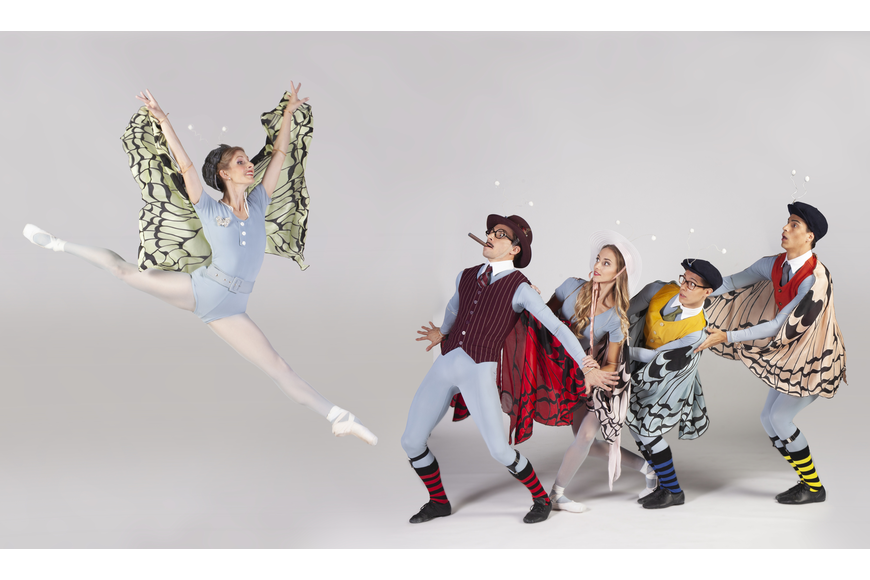
There’s the “Mistake Waltz” (shades of childhood ballet recitals with dancers out of sync and out of place), a parody pas de deux; a parade of umbrellas when it appears not to be raining; and a strange sequence when everyone turns into a winged creature (chased after, with a giant net, by the pianist). It can’t compete with the choreographic genius of Robbins in, say “West Side Story,” but it’s certainly a fun lark.
As Sarasota Ballet triple bills often do, this one covered all the bases — a flurry of technical brilliance, a tug at the heartstrings and a good belly laugh. That’s not only good programming, it’s a tribute to this company’s ability to take on both the physical and emotional demands of such a diverse repertoire and, for the most part, to pull them off with admirable success.
from the program booklets-


I was awed by the male lead in Rhapsody and enjoyed the Wheeldon very much- but the Concert not so much- I am not sure vaudeville translates into dance (at least for me) - others seemed to enjoy it more than I... but alas - that's what makes a horse race as they say...