So today I went off to the Jewish Film Festival to see films two and three for me- Phil joined me for film #3 -
I liked them in the order that I saw them with yesterdays charming Shalom Italia in the first position and then second Fire Birds and finally Kind Words. Overall I liked them all - Phil wasn't keen on Kind Words because he didn't like the main character but I had real sympathy for her and liked the fact that the story was not predictable and was quite complex (something you rarely see in American films.)
So as if we weren't busy enough we also had to come home and go through the catalogue for the Sarasota Film Festival tonight before I leave because tickets go sale to the general public while I am away for the next two weeks-
so we picked about twenty films between the two of us (13 for me and 7 for Phil) and bought our tickets while they were on pre-sale...
meanwhile- back to the current film fest... the first film Fire Birds was a tale of poetic justice with a lot of quirky characters including a fading glamour-puss who still saw herself as a full blown star...
overall - the three films I saw were winners in my book... I would look for Shalom Italia and Fire Birds... both worth seeing -
and now off to my trip so you won't be hearing from me for a few weeks! but stay tuned!
a blog about my semi-free-life after 30+ years of law (travel, food, theater, and an occasional rant)
Showing posts with label holocaust. Show all posts
Tuesday, March 14, 2017
Monday, March 13, 2017
a hit with us
so off we went this afternoon to the Jewish Film Festival in Sarasota... and the first film we saw was a big hit with both of us.... a story of three brothers in their 80s who come back to Italy (where they were born and lived during the war) to locate the cave where they had hidden with three generations of their family to escape the Holocaust. The brothers - of course - all had different memories of the time the family lived in the cave and how difficult it was (they were there a year).
so during the movie they were looking for the cave and spending time reminiscing and eating - LOL -
hey it's a film about Jews - of course there is food... they go to the market and buy food, they prepare food, they have a nice dinner in the "fancy" living room on Shabbat - and near the end a huge family meal to conclude their time together.
The oldest of the three brothers is an anthropologist and another is a physicist and the third was either never clear or I didn't catch it... in order of the vocations above- Meme (Emmanuel) - Andrea - and Bubi (whose given name was Reuven - all last name Anati (now).
here is a lovely synopsis of the movie from the website of Bernard Dichek-
http://www.bdichek.com/uncategorized/reflections-from-a-cave/
some editing for clarity -
So we came home feeling like it was a very worthwhile couple of hours- tomorrow I have two films scheduled and Phil will join me for one - then he has another on Friday after I have left for my trip... so stay tuned...
so during the movie they were looking for the cave and spending time reminiscing and eating - LOL -
hey it's a film about Jews - of course there is food... they go to the market and buy food, they prepare food, they have a nice dinner in the "fancy" living room on Shabbat - and near the end a huge family meal to conclude their time together.
The oldest of the three brothers is an anthropologist and another is a physicist and the third was either never clear or I didn't catch it... in order of the vocations above- Meme (Emmanuel) - Andrea - and Bubi (whose given name was Reuven - all last name Anati (now).
here is a lovely synopsis of the movie from the website of Bernard Dichek-
http://www.bdichek.com/uncategorized/reflections-from-a-cave/
some editing for clarity -
Emmanuel Anati, 84, is addressing an annual conference of psychoanalysts in Sicily. An eclectic scholar, world-renowned for his expertise in archeology, anthropology and pre-historic art, Anati, for years, has been invited by this elite group to share his observations about various subject matters. This year, the topic is solitude. “My dear colleagues,” begins Anati. He pauses and then continues. “For the first time, I am going to talk to you about something personal.” This brief dramatic moment is included in the epilogue to the new Israeli documentary Shalom Italia (Hebrew version: Three Brothers and a Cave). Emmanuel, in the course of his lecture, will harken back to his childhood in Italy.
He has just completed a journey with his two younger brothers in which the three visited the places where they grew up and hid during the Holocaust – places they had not been to in some 70 years.... an intriguing character study of the three brothers around their late-life road trip that is rich with humor, yet unspoiled by a single maudlin moment. Bubi [Reuven Anati], the youngest of the three brothers, mentioned that he was headed to Italy where he was determined to find the cave where he and his family hid during the Holocaust. His two older brothers, Andrea and Emmanuel, after a bit of convincing, had agreed to go with him. The Anati brothers consented, and a month later the five flew to Rome where they squeezed into a Fiat Panda and drove into the Tuscany countryside.
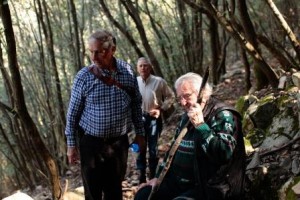
The brothers had never before traveled together without their wives and children. They also had never tried to find their old family home in Florence or talked very much, among themselves or with anyone else, about what happened to them when they were children. The Anati family, headed by Hugo, a well-established architect, and Elza had lived in Florence for generations. In 1942, as Jews were being rounded up and deported to Auschwitz, Hugo and Elza, two grandmothers and their four sons, including Gabriel who died 20 years ago, fled into the countryside. During the next three years, they moved from one hiding place to another.
The dramatic structure of the film revolves around the attempt of Emmanuel, Andrea and Bubi to locate one hiding place in particular – a cave, high up in the mountains, that was their last safe refuge. They wander around the forest, equipped with nothing more than picnic baskets, examining every possible lead. Where exactly was the cave? What was it like living there? Is it possible that there really wasn’t a cave, after all? It soon becomes clear that whether or not they find the cave is not of paramount importance. “They have become like they were as children again. And, now, despite all of their differences, the brothers can decide if they want to accept each other’s story as it is.”
As they climb, talk, argue, laugh, gaze into the breathtaking Tuscany scenery, and partake of local wines, cheeses, tomatoes and salamis, we begin to get a picture of three very different personalities with three very dissimilar recollections of the past.
Serious-minded Emmanuel, who was 14 years old when the family began its odyssey, is skeptical about many of the stories the others seem to recall. He speaks about the past with a sense of loneliness. Andrea, cheerful in demeanor, 12 at the time, recalls playing Robin Hood with bows and arrows in the woods. “We had fun in the Holocaust,” he says unabashedly. He often is seen trotting up and down the mountainside ahead of the others. Easy-going Bubi, 4 at the time, doesn’t really have too many first-hand memories but draws on stories he has heard from others. He initiated the trip and he is the most curious.
“What really interested me in making this film was exploring the way memories influence our lives,” says Tal (the film maker and a family member). “I tried to focus on what happens when a group of siblings relive their childhood and unravel strands of memories. I wanted to let the viewer be in that moment with them and observe the effect it has on them.” The film doesn’t include on-camera interviews or other didactic documentary techniques; instead, it emphasizes contemplative dialogues, melancholy and humorous sequence and lyrical renditions of landscapes as the brothers slowly come to terms with each other.
Emmanuel, who was forced away from his studies and friends at an early age, has built his career around academic study and seems most at ease wandering around the isolated desert landscape near his home in the Negev. Andrea, the nature child, now in his eighties, continues to be a nature lover, spending his weekends pulling himself up and down mountains with climbing ropes. Bubi, is a bit like both Andrea and Emmanuel. Like Andrea, he is immersed in nature and has built a career designing natural science parks around the world. Like Emmanuel, he was not willing – until now – to face the past, and previously did not attempt to venture near the family home in Florence, even though he spends half the year living in Italy.
Wednesday, June 3, 2015
the Jews in Amsterdam
Wherever we go in the world - if there is anything to do with the Jews, we find it... I am not Jewish- my family sports multigenerational a-religious background. Yes, I was baptized - not once but twice, LOL but a follower of one sect or another I have never been. Around our household we say I belong to the Church of Victoria Sterling. However, my husband despite being an atheist, was raised in a very traditional Jewish household and went to Hebrew school multiple days a week and the kitchen was kept kosher and he did the whole tied up in leather thing etc... so of course he rebelled. He is however deeply "ethnically Jewish" and therefore we do all the Jewish sights wherever we travel.
Amsterdam is steeped in Jewish history, and has had a continuing Jewish community for the last 370 years. Despite years of religious tolerance, unlike Denmark, the Dutch community did little to stop the advance of the Nazi extermination program. While this statement is not true of individual Netherlanders, as a state, the failure to protect longstanding members of the community (as they did in Denmark) ultimately resulted in a near annihilation of the Jews in Amsterdam. The Holocaust deeply affected the Jewish community, killing some 80% of the some 80,000 Jews present at that time in Amsterdam.
Permanent Jewish life in Amsterdam began with the arrival of pockets of Marranos and Sephardic Jews at the end of the 15th. Although many Sephardim had been expelled from Spain and Portugal in 1492 (the Reconquest) others remained in the Iberian peninsula, practising Judaism in secret. In 1593 many arrived in Amsterdam. These Jews were important merchants and persons of great ability. Their expertise contributed materially to the prosperity of the country. They became strenuous supporters of the House of Orange and were in return protected by the state.
The first Ashkenazim in Amsterdam were refugees from the Thirty Years War. Their numbers soon swelled, eventually outnumbering the Sephardic Jews at the end of the 17th century. By 1674, some 5,000 Ashkenazi Jews were living in Amsterdam, while 2,500 Sephardic Jews called Amsterdam their home. Many of the new Ashkenazi immigrants were poor, contrary to their relatively wealthy Sephardic brethren. They were only allowed in Amsterdam because of the financial aid promised to them and other guarantees given to the Amsterdam city council by the Sephardic community, despite the religious and cultural differences between the Yiddish-speaking Ashkenazim and the Portuguese-speaking Sephardim. (above in blue from wikipedia)
So our explorations of the Jewish Quarter began at the Jewish History Museum - which has an excellent exhibit in the old synagogue of the various Jewish religious rituals and celebrations.
this painting depicts the family of mourners sitting shiva and the minion of men to say the prayers-
a kit for ritual circumcision
the Jewish wedding ceremony under the "canopy" - here a large veil draped over the couple -
in the next section - an exhibit on various aspects of the Jewish diaspora - including the islands and colonies which were once part of the Dutch Empire-
here a statute erected to the dock workers who went on strike to protest the initial roundup of the Jews by the Nazis during occupation. The strike was ineffective in stopping the deportation of the vast majority of the Jews (80% of whom died in the death camps)
a Holocaust Memorial has been erected inside the ruins of the theater where the Nazis gathered the Jews to put them into rail cars for deportation.
those numbers are horrifying - and only really made possible by this document that gave the Nazis the location of all the Jewish families in Amsterdam-
we later visited the Portuguese Synagogue- in use today- but unheated and without electricity so services in the winter are held in this winter synagogue in a small section of the property.
a former mikvah (ritual bath) located at the synagogue-
they have a permanent installation of a sukkah for their Sukkot festival -
a permanent room on the grounds for mourning and funeral services
It must be quite magnificent all lit up with the candles -
we also toured the Dutch Resistance Museum - which is an excellent exploration of the various choices made by individual Dutch people to combat the spread of Nazism and to lend assistance to the Jews. It covered the period of the occupation through liberation by the Allied forces in Europe -
a striking gallery on the death camp experience of the Jews was harrowing but educational
Although things started out so well centuries back for the Jews in Amsterdam, the community as a whole did not react to the Nazi orders the way Denmark did (who said - "we are all Danes" and refused to identify specific families as one religion or another)... and the reason that only Denmark - of all countries of the world is recognized as a Nation- of Righteous Gentiles at Yad Vashem in Israel.
Today the Jewish population in Amsterdam is small, after the war ended - what few Jews returned were given no help in reestablishing their households (many of which had been looted of all their possessions) and most moved on... a sad tale and at least to me, a blot on the boasts that Amsterdam makes of being such an open and free society for centuries.... but which in no way undercuts the heroic acts of individuals who stepped forward to hide and assist Jews during the war. so many that it has the largest number of recognized individuals on Yad Vashem's Righteous Gentiles lists.
A checkered story with many shades of grey explored so well in the Resistance Museum, so we make a very strong recommendation for that one.
In the next post - we explore the city history at the Amsterdam Museum. So stay tuned!
Amsterdam is steeped in Jewish history, and has had a continuing Jewish community for the last 370 years. Despite years of religious tolerance, unlike Denmark, the Dutch community did little to stop the advance of the Nazi extermination program. While this statement is not true of individual Netherlanders, as a state, the failure to protect longstanding members of the community (as they did in Denmark) ultimately resulted in a near annihilation of the Jews in Amsterdam. The Holocaust deeply affected the Jewish community, killing some 80% of the some 80,000 Jews present at that time in Amsterdam.
Permanent Jewish life in Amsterdam began with the arrival of pockets of Marranos and Sephardic Jews at the end of the 15th. Although many Sephardim had been expelled from Spain and Portugal in 1492 (the Reconquest) others remained in the Iberian peninsula, practising Judaism in secret. In 1593 many arrived in Amsterdam. These Jews were important merchants and persons of great ability. Their expertise contributed materially to the prosperity of the country. They became strenuous supporters of the House of Orange and were in return protected by the state.
The first Ashkenazim in Amsterdam were refugees from the Thirty Years War. Their numbers soon swelled, eventually outnumbering the Sephardic Jews at the end of the 17th century. By 1674, some 5,000 Ashkenazi Jews were living in Amsterdam, while 2,500 Sephardic Jews called Amsterdam their home. Many of the new Ashkenazi immigrants were poor, contrary to their relatively wealthy Sephardic brethren. They were only allowed in Amsterdam because of the financial aid promised to them and other guarantees given to the Amsterdam city council by the Sephardic community, despite the religious and cultural differences between the Yiddish-speaking Ashkenazim and the Portuguese-speaking Sephardim. (above in blue from wikipedia)
So our explorations of the Jewish Quarter began at the Jewish History Museum - which has an excellent exhibit in the old synagogue of the various Jewish religious rituals and celebrations.
this painting depicts the family of mourners sitting shiva and the minion of men to say the prayers-
a kit for ritual circumcision
the Jewish wedding ceremony under the "canopy" - here a large veil draped over the couple -
in the next section - an exhibit on various aspects of the Jewish diaspora - including the islands and colonies which were once part of the Dutch Empire-
here a statute erected to the dock workers who went on strike to protest the initial roundup of the Jews by the Nazis during occupation. The strike was ineffective in stopping the deportation of the vast majority of the Jews (80% of whom died in the death camps)
a Holocaust Memorial has been erected inside the ruins of the theater where the Nazis gathered the Jews to put them into rail cars for deportation.
those numbers are horrifying - and only really made possible by this document that gave the Nazis the location of all the Jewish families in Amsterdam-
we later visited the Portuguese Synagogue- in use today- but unheated and without electricity so services in the winter are held in this winter synagogue in a small section of the property.
a former mikvah (ritual bath) located at the synagogue-
they have a permanent installation of a sukkah for their Sukkot festival -
a permanent room on the grounds for mourning and funeral services
a couple of photos of the interior of the main synagogue-
It must be quite magnificent all lit up with the candles -
we also toured the Dutch Resistance Museum - which is an excellent exploration of the various choices made by individual Dutch people to combat the spread of Nazism and to lend assistance to the Jews. It covered the period of the occupation through liberation by the Allied forces in Europe -
a striking gallery on the death camp experience of the Jews was harrowing but educational
Although things started out so well centuries back for the Jews in Amsterdam, the community as a whole did not react to the Nazi orders the way Denmark did (who said - "we are all Danes" and refused to identify specific families as one religion or another)... and the reason that only Denmark - of all countries of the world is recognized as a Nation- of Righteous Gentiles at Yad Vashem in Israel.
Today the Jewish population in Amsterdam is small, after the war ended - what few Jews returned were given no help in reestablishing their households (many of which had been looted of all their possessions) and most moved on... a sad tale and at least to me, a blot on the boasts that Amsterdam makes of being such an open and free society for centuries.... but which in no way undercuts the heroic acts of individuals who stepped forward to hide and assist Jews during the war. so many that it has the largest number of recognized individuals on Yad Vashem's Righteous Gentiles lists.
A checkered story with many shades of grey explored so well in the Resistance Museum, so we make a very strong recommendation for that one.
In the next post - we explore the city history at the Amsterdam Museum. So stay tuned!
Subscribe to:
Posts (Atom)


